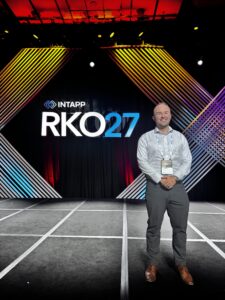

A day well spent at Dynamo Partner Day 2026 in Boston, where partners and product leaders came together to share what’s next for the platform and, more importantly, what it means in practice.
For firms using Dynamo today, the announcements weren’t simply about new features. They offered a clear view of how the platform is evolving and what firms need to do now to take advantage of what’s coming next.
What stood out wasn’t just the volume of innovation, but how Dynamo is evolving the platform to embed AI in ways that help users realise its full potential.
This is no longer about incremental improvements
There’s a noticeable shift in how Dynamo is positioning itself.
This is not a roadmap of small upgrades. It’s a move toward becoming a system that actively works with your data, not just stores it.
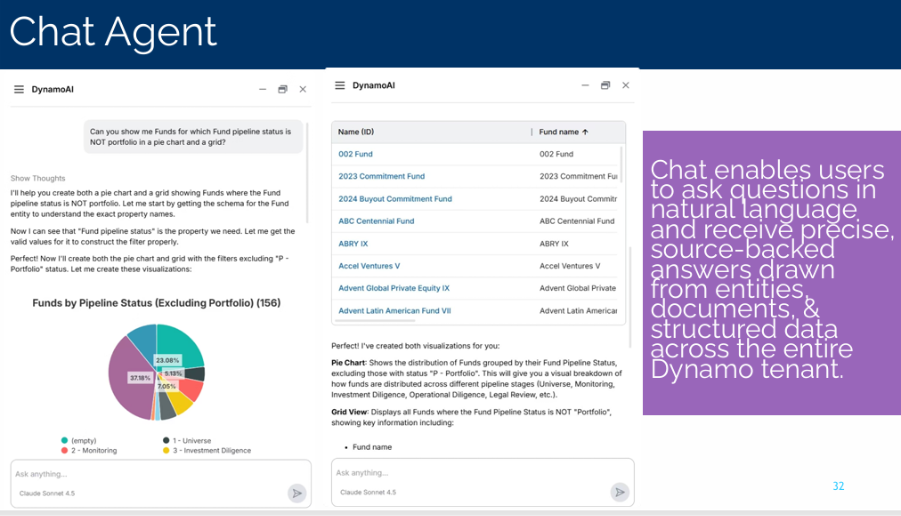
The clearest signal of that is the introduction of agentic AI across the platform.
Five distinct agents are being embedded into workflows:
- Data Automation.
- Data Extraction.
- Productivity.
- Chat.
- Research.
Collectively, they are designed to move firms closer to something that’s been talked about for years but rarely delivered: zero manual data entry and genuinely automated reporting.
The direction is clear. Data comes in, gets structured, interpreted, and turned into output with minimal human handling.
But that only works if the underlying environment can support it.
Dynamo 3.0 is the enabler, not just the upgrade
A recurring theme throughout the day was that, to take advantage of these capabilities, the platform experience had to be rebuilt from the ground up.
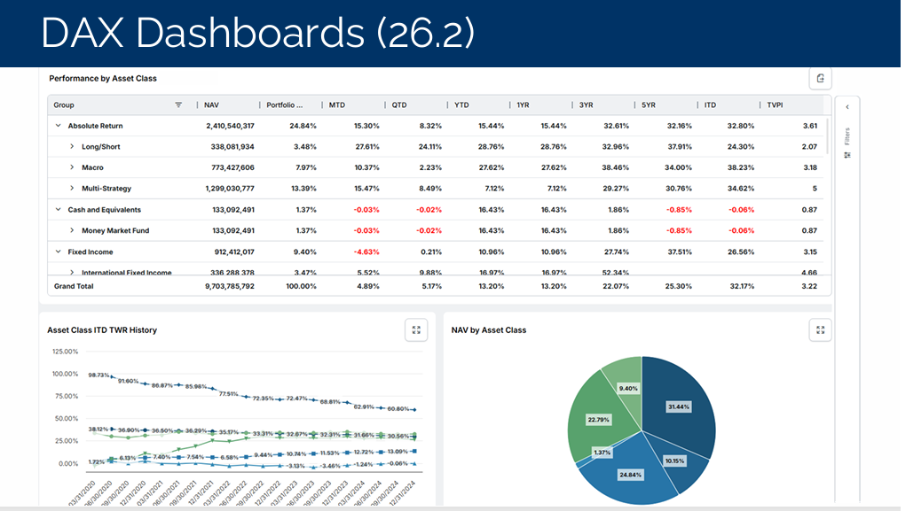
You see it immediately in the interface:
- Hubs replacing workspaces.
- Tabs enabling faster access to key insights and results without the need for extensive customisation.
- DAX-powered dashboards.
- More flexible visualisation and reporting.
- A redesigned LP and partner portal.
This is not just a cleaner UI. It’s a shift toward a model where users interact with live, interrogatable data, rather than static records.
And that matters, because AI-driven workflows depend on that level of structure and accessibility.
The gap between 2.0 and 3.0 is widening quickly
One of the more candid takeaways from the event is how deliberate the separation now is.
If you remain on Dynamo 2.0, you are effectively stepping outside of the innovation cycle.
That includes:
- The new AI agent framework.
- Upcoming integrations.
- Enhancements in reporting and dashboards.
Even integrations such as Microsoft Teams, Zoom and banking feeds through Plaid are being built with the 3.0 architecture in mind.
This isn’t positioned as pressure. But in practice, it creates a very real divide between firms that can adopt new capabilities and those that can’t. Bridging that gap isn’t just about switching versions: it requires the right approach to migration and adoption. That’s where it|venture plays a key role, helping clients move from 2.0 to 3.0 in a way that unlocks the full value of the platform and its latest capabilities.
Integrations are becoming part of the operating model
Another theme that came through strongly is that Dynamo is no longer thinking about integrations as add-ons.
They are becoming part of the core workflow layer.
Upcoming developments include:
- Teams and Zoom integrations with automatic summaries and syncing.
- Semantic search across documents.
- Models that respect and enforce user permissions.
- Early direction toward MCP to support broader interoperability.
The intent here is clear: reduce the friction between systems and bring more context directly into Dynamo.
Not just data, but conversations, documents, and decisions.
AI is only as strong as the structure underneath it
If there was one underlying message across the sessions, it’s this:
AI doesn’t hide complexity. It exposes it.
The promise of automated data flows and report generation is real, but only when:
- Data is structured consistently.
- Permissions and governance are clearly defined.
- Systems are aligned around a single source of truth.
Without that, AI becomes another layer on top of existing inefficiencies.
With it, it becomes a genuine accelerator.
Where this leaves firms today
The takeaway from Dynamo Partner Day isn’t that AI is coming, because that much is already understood.
It’s that the benefits are becoming increasingly conditional.
Conditional on:
- Being on the right version of the platform (3.0).
- Having the right data foundations in place.
- Approaching migration as a business change, not just a technical one.
That’s where we’re seeing the real work happening with clients – bridging that gap between platform capability and operational readiness.
Final thoughts
Dynamo is moving quickly toward a more intelligent, automated platform.
But the firms that benefit most will not be the ones that only adopt the technology first. They’ll be the ones that are ready for it.
Turn insight into action
Dynamo 3.0 opens the door to AI-driven efficiency, but only for firms ready to take advantage of it.
We help clients plan and deliver successful migrations, optimise their platform and build a long-term strategy that unlocks the full value of Dynamo 3.0.
Authors

Christopher Doane
Principal Consultant

William Collier
Product Owner – Connect